
Thumb pain can seem minor at first. You might notice a slight ache when opening a jar, lifting a coffee cup, using your phone, or gripping gym equipment. Over time, though, that discomfort can become sharper, more constant, and harder to ignore.
If you are dealing with pain on the thumb side of the wrist, especially when gripping, lifting, pinching, or twisting, one possible cause is De Quervain’s tenosynovitis. This is a common reason for thumb pain and wrist pain on the thumb side, particularly in people who use their hands repetitively at work, at home, or in training. De Quervain’s affects the tendons on the thumb side of the wrist and commonly causes pain with gripping, fist-making, and turning the wrist.
At Flynn Chiro, we see this kind of thumb side wrist pain in office workers, new parents, gym-goers, tradies, and people spending long hours on a mouse or phone in Melbourne CBD.
What Is De Quervain’s Tenosynovitis?
De Quervain’s tenosynovitis is an irritation involving two tendons that help move the thumb. These tendons pass through a small sheath on the thumb side of the wrist. When that sheath becomes irritated or thickened, the tendons cannot glide as smoothly, which can lead to pain, swelling, and restricted movement. This condition is commonly linked with repetitive hand and wrist movements such as lifting, gripping, twisting, squeezing, and pinching.
Unlike general wrist soreness, the pain is usually quite localised. Most people feel it near the base of the thumb and along the thumb side of the wrist. Daily tasks can quickly become aggravating because those tendons are involved in so many routine movements.
Still Dealing With Pain That Keeps Coming Back?
Whether it’s neck pain, back pain, headaches, or stiffness from long hours at work, Dr Flynn can help you understand what’s driving the problem and start moving better again.
What Does Thumb Side Wrist Pain Feel Like?
De Quervain’s pain is often described as a sharp or aching discomfort on the thumb side of the wrist. In some cases, the pain may travel slightly up the forearm. It often feels worse during gripping, lifting, wringing, pinching, or twisting activities. Common symptoms include pain and tenderness along the thumb side of the wrist, swelling in that area, and pain that worsens with hand and thumb use.
You may also notice:
- pain when gripping or pinching
- swelling near the base of the thumb
- weakness with lifting or grasping
- stiffness first thing in the morning
- a catching or snapping sensation with thumb movement
Some people say it feels like their thumb or wrist does not want to move smoothly. Others find even simple actions such as holding a baby, opening containers, or using a phone become uncomfortable.
Why Thumb Pain Is So Common In Melbourne CBD
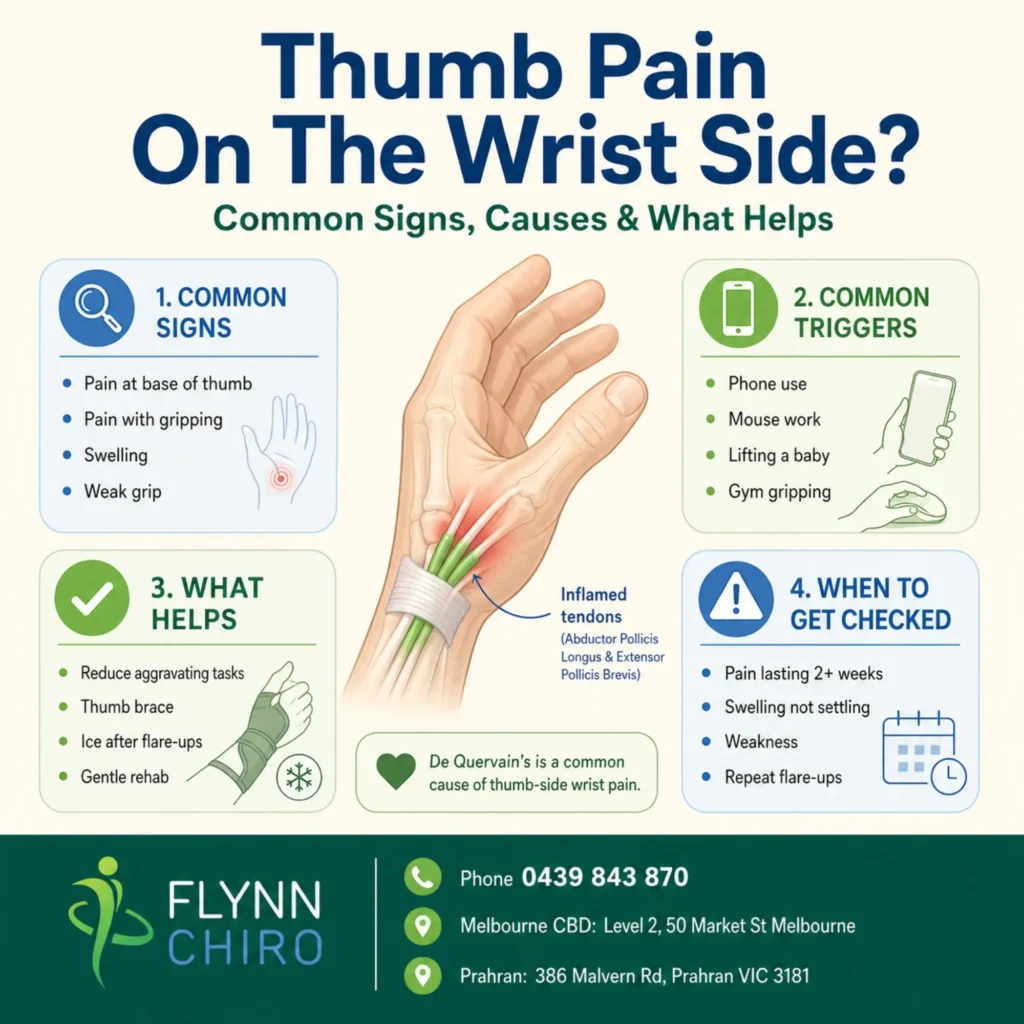
Modern work habits play a major role. Many professionals in Melbourne CBD spend hours typing, using a mouse, scrolling on a smartphone, or gripping devices repeatedly. Repetitive thumb and wrist movements are among the most common causes of De Quervain’s symptoms.
Outside work, the condition is also common in:
- new parents repeatedly lifting a baby
- gym-goers over-gripping dumbbells or kettlebells
- people doing gardening or DIY
- anyone suddenly increasing manual or repetitive hand activity
In many cases, it is not one major injury. It is the build-up of repeated small stresses without enough recovery.
Who Is More Likely To Develop It?
De Quervain’s can affect anyone, but it is more common in women and is often seen during the postpartum period. Repetitive lifting and hormonal changes may contribute. People with inflammatory conditions or diabetes may also have a higher risk, and symptoms can begin after a sudden increase in activity or load.
A Simple Check: The Finkelstein Test
A commonly used clinical test for De Quervain’s is the Finkelstein test. This involves placing the thumb into the palm, wrapping the fingers over it, and then bending the wrist toward the little finger side. If this produces pain along the thumb side of the wrist, it can suggest De Quervain’s. Health providers commonly use this manoeuvre during assessment, but it is not a complete diagnosis on its own.
If you try this movement and it reproduces your exact pain, it is a sign that a proper assessment may be worthwhile.
De Quervain’s Vs Other Causes Of Thumb Pain
Not all thumb pain is De Quervain’s. Thumb pain may also come from thumb arthritis, carpal tunnel syndrome, or other wrist problems. Carpal tunnel syndrome is more commonly linked with numbness and tingling in the thumb, index, and middle fingers, while De Quervain’s tends to produce pain specifically along the thumb side of the wrist and is usually aggravated by thumb motion, gripping, or twisting.
This matters because treatment works best when the pain source is identified accurately.
Will De Quervain’s Heal On Its Own?
Mild cases may improve with rest and activity modification, especially if the aggravating movement is reduced early. However, many people continue using the wrist in the same way through work, parenting, or exercise, which can keep the irritation going. Most people need a period of reduced aggravation, splinting, or other conservative care for symptoms to settle properly.
If your thumb pain has been present for more than a couple of weeks, or if it keeps returning, it is worth having it assessed rather than simply pushing through it.
Thumb Pain Treatment Melbourne CBD
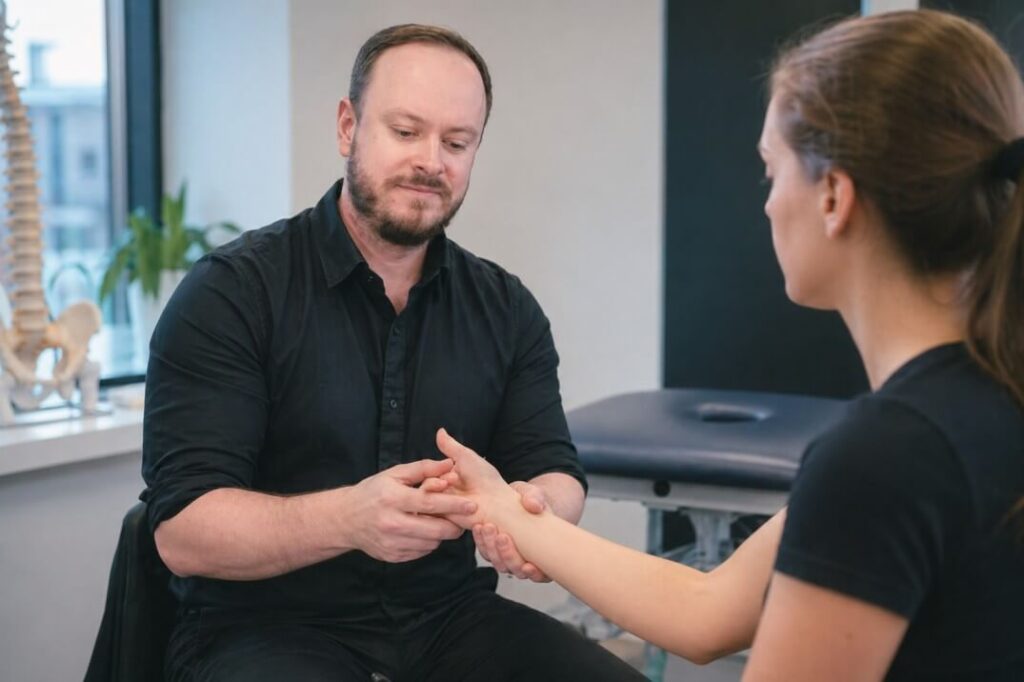
The right thumb pain treatment depends on how irritated the tendons are and what is continuing to overload them.
Early management usually includes reducing aggravating movements, especially repetitive gripping, lifting, twisting, and scrolling. A thumb spica splint or brace is commonly used to rest the tendons and reduce strain, and ice can be helpful in the early phase for short periods. Conservative treatment commonly includes splinting, ice, and reducing irritating activity.
Rehabilitation is also important. Once pain begins to settle, the thumb and wrist usually need gradual reloading so the tendons can tolerate daily demands again. A complete recovery plan often includes:
- activity modification
- temporary bracing or splinting
- gentle tendon and wrist mobility work
- progressive strengthening
- review of work, gym, or parenting mechanics
In more persistent cases, corticosteroid injections may be considered to help reduce inflammation in the tendon sheath, while surgery is usually reserved for cases that do not improve with conservative care.
When To Seek Professional Help
It is sensible to seek assessment if you notice:
- thumb pain lasting more than two to three weeks
- swelling or weakness that is not improving
- pain that is limiting work, training, or lifting
- ongoing flare-ups every time you return to normal activity
- a catching or stuck sensation in the thumb or wrist
Early management is often easier than trying to settle a problem that has been irritated for months.
Prevention For Office Workers, Parents, And Gym-Goers
Prevention usually comes down to reducing repeated overload.
Helpful strategies include:
- keeping the wrist in a more neutral position during work and training
- avoiding unnecessary over-gripping
- adjusting mouse and keyboard position
- taking short breaks during repetitive hand tasks
- increasing training loads gradually rather than all at once
Tendons typically adapt more slowly than muscles, so even if your grip feels strong, the tissues may still be overloaded if volume rises too quickly.
How Flynn Chiro Can Help
If you are looking for Thumb Pain Treatment in Melbourne CBD, Flynn Chiro offers assessment and care focused on identifying what is driving the problem. With De Quervain’s, the issue is not always limited to the thumb alone. Wrist movement, forearm tension, shoulder mechanics, and repetitive work patterns can all contribute.
At Flynn Chiro, care may include hands-on treatment, advice on modifying aggravating tasks, and guidance around movement and loading so the thumb and wrist are not continually irritated. The aim is to support recovery, improve movement, and reduce the chance of repeated flare-ups.
Frequently Asked Questions
What is the most common cause of pain on the thumb side of the wrist?
One common cause is De Quervain’s tenosynovitis, which affects the tendons on the thumb side of the wrist and often becomes painful with gripping, twisting, and lifting.
How do you relieve thumb pain quickly?
Reducing aggravating tasks, using a supportive splint, and icing the area may help in the early phase. Longer-term improvement usually depends on correcting the repeated strain that caused the irritation. Conservative care often includes a splint or brace plus activity modification.
Will De Quervain’s heal without treatment?
Mild cases sometimes settle with rest and reduced aggravation, but ongoing repetitive strain often keeps the symptoms active.
What does De Quervain’s pain feel like?
It usually feels like sharp or aching pain near the base of the thumb and along the thumb side of the wrist, often worse with gripping or turning the wrist. Swelling and tenderness are also common.
Do I need surgery for De Quervain’s?
Usually not. Most cases are managed conservatively first, and surgery is generally only considered when symptoms do not improve with non-surgical care